Spanish must first become hearable.
Pronunciation, rhythm and decoding are treated as central from the beginning. If the sound system is unstable, listening and speaking become unnecessarily heavy.
THE NEXO ELE METHOD · TEN-LEVEL SPANISH ARCHITECTURE
NEXO ELE is a premium online Spanish method for adults who need order, precision and fluency. Instead of forcing your Spanish through broad A1–C2 labels, we diagnose your real architecture and rebuild it through a more granular ten-level progression.
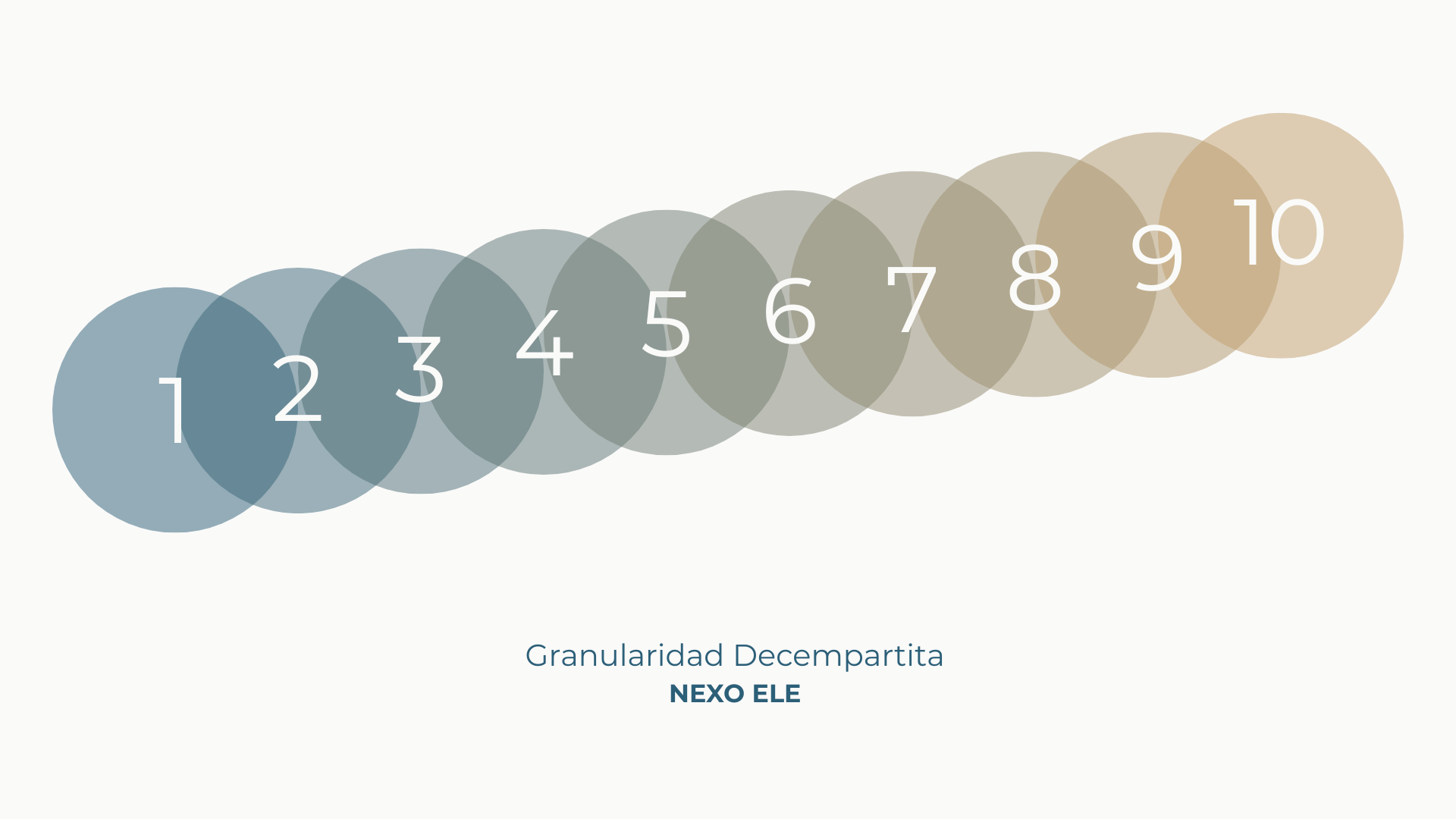
The traditional CEFR scale is useful for certification, but adult learners often need a more precise learning map. NEXO ELE translates that broad structure into ten operational stages, so your Spanish can progress with less overload and more stability.
NEXO ELE does not simply add more vocabulary or grammar. It reorganises the learning process so that adult learners can stabilise what they know and use it under real pressure.
Pronunciation, rhythm and decoding are treated as central from the beginning. If the sound system is unstable, listening and speaking become unnecessarily heavy.
The method protects the learner from premature complexity. Each level consolidates a specific function before the next layer is introduced.
Rules are not treated as museum pieces. They appear when they help you speak, react, solve problems, explain yourself and live in Spanish.
Adult learners often fail not because the content is impossible, but because too many demands arrive simultaneously: sound, vocabulary, grammar, speed, emotion and social pressure. NEXO ELE controls that load by sequencing the learning path more carefully.
The goal is not to make Spanish superficial. The goal is to make complexity arrive at the right time.
The NEXO ELE experience uses an inverted logic: simple explanations and preparation can happen before the session; the live class is reserved for speaking, feedback, correction, interaction and real use.
This gives the adult learner more time to process privately and more support when real production begins.
Each stage has a specific cognitive and communicative function. The aim is not to rush through levels, but to make sure your Spanish remains stable when you actually need it.
Sound, basic routines, pronunciation, classroom language and first survival chunks.
Present, identity, needs, location, basic interaction and immediate everyday life.
Past events, factual narration, experience and basic real-world problem solving.
Context, imperfect, narrative background, future projection and functional confidence.
Wishes, advice, feelings, first subjunctive uses and personal transformation.
Argumentation, connectors, complex sentences and more controlled interaction.
Abstract opinions, contrast, condition, hypothesis and stronger argumentative control.
Nuance, pragmatic precision, humour, register shifts and advanced conversational flexibility.
Style, mediation, lexical density, professional expression and complex discourse.
Cultural depth, academic precision, dialectal awareness and architecture of nuance.
The free diagnostic orientation gives you a first map of your Spanish: what is stable, what blocks and what should be rebuilt first.
Take the free diagnostic test. Then send your result to Fran on WhatsApp so he can help you understand the clearest route forward.